Heaven
Paradise LostHeaven is the poem’s supreme sacred location: an empyreal realm of light, hierarchy, worship, and divine government from which Creation proceeds and against which rebellion defines itself. It is at once the home of the Heavenly Host, the throne-world of God and the Son of God, the source of humanity’s created order, and the measure by which Hell, Earth, and the history of mankind are judged. Its decisive significance lies in the contrast between the harmony of rightful obedience and the ruin produced when freedom turns against the order that gives it meaning.
Nature and Divine Setting
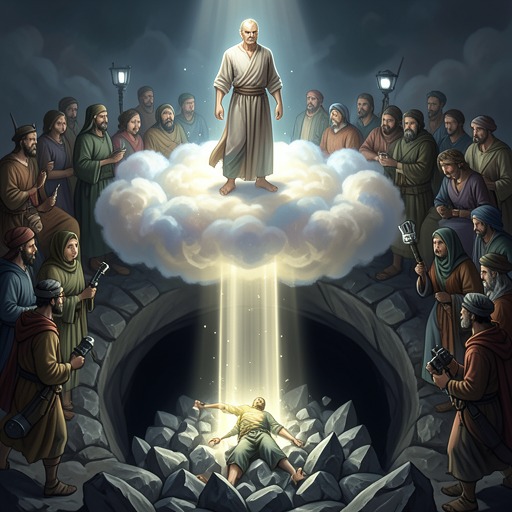
Heaven is presented as a realm of inaccessible brightness, associated with the pure Empyrean and with God’s eternal light. The poem’s opening invocation distinguishes the darkness within the human speaker from the radiance that Heaven possesses, asking celestial illumination to raise what is low and clarify what is obscure. Heaven therefore functions not merely as a place but as a standard of knowledge: its light signifies vision, purity, and the intelligibility of divine Providence, while the failure to perceive it belongs to mortal limitation and spiritual darkness.
Its order is both spatial and political. Before God’s throne stand the Sanctities of Heaven, arranged in hierarchies and bright degrees; innumerable Angels gather under their Hierarchs, carrying standards and memorials of zealous service and love. Thrones, Dominations, Princedoms, Virtues, and Powers form an ordered celestial society whose distinctions do not initially contradict freedom. The Son of God is declared the appointed Head of this order, and the decree that every heavenly soul shall acknowledge him establishes authority as participation in a larger unity rather than as arbitrary domination.
Heaven also contains ceremonial and communal life. Its inhabitants celebrate solemn days with song and mystical dance, whose intricate circular patterns resemble the ordered motions of the stars and planets. At evening they turn from dance to a communal feast of Angels’ Food and heavenly Nectar, served amid Pearl, Diamond, Gold, and the fruit of delicious Vines. Even Night in Heaven is not an oppressive darkness but a grateful Twilight, a change that refreshes rather than threatens. These recurring alternations of song, movement, nourishment, light, and shade make Heaven a living order whose harmony is both aesthetic and theological.
Throne, Law, and Legitimate Rule
God’s throne is the center from which Heaven receives beatitude, command, and political coherence. At God’s right hand sits the radiant image of his Glory, the Son of God, whose authority is presented as grounded in divine generation and creative mediation. God declares him the only Son, anoints him on the holy hill, appoints him Head of the Angels, and binds heavenly obedience to recognition of his lordship. In this structure, the Son’s reign does not diminish the glory of the celestial orders; rather, his headship unites them and returns the honor paid to him to the order of which he is part.
This legitimacy becomes the central issue in Satan’s challenge. Satan argues that the Angels are free and, if not equal in power, equal in freedom; he therefore treats the Son’s sovereignty as an imposed yoke and portrays homage as degradation. His argument converts the language of liberty into a claim of self-rule, rejecting the authority of the Creator and denying that created beings owe their existence and powers to another. Abdiel answers that God made the heavenly Powers as he pleased and that the Son, through whom the Father made all things, is not an alien tyrant but the rightful Head of their own order. The dispute thus separates liberty from license: Heaven’s political ideal is freedom joined to reason, gratitude, and obedience, whereas Satan’s version of freedom seeks independence from every originating authority.
Heaven’s law is severe because it treats disobedience as a rupture of union. God’s decree warns that the Angel who disobeys him disobeys the order itself and falls from blessed vision into darkness without redemption. Yet the law is not represented as arbitrary. Abdiel insists that God is provident toward the dignity of the Angels and intends to exalt their happiness through a common Head. Heaven’s government therefore combines monarchy with a claim of benevolent order, while the poem’s political theology distinguishes that legitimate sovereignty from Satan’s later tyranny and from human rulers who usurp dominion over their equals.
Rebellion and Expulsion
Heaven is the origin of the Rebel Angels’ former glory and the site of their catastrophic defeat. Satan, once a princely Power of Heaven, becomes consumed by ambition, envy, and revenge. He seeks to raise war against God’s throne and monarchy, attempting to equal the Most High. God hurls him and his host flaming from the ethereal sky into perdition, where they lie vanquished in the fiery gulf before Satan’s mind turns from lost happiness toward renewed revenge.
The rebellion is not only a military conflict but also a crisis of political language. Satan gathers the Angels beneath his palace on the Mountain of Congregation, a structure designed in imitation of the holy mountain where the Son of God was proclaimed. There he presents a false account of the divine decree, suggesting that the enthronement of the Son has eclipsed the older celestial powers and demanding resistance to knee-tribute and prostration. The palace becomes a counter-image of Heaven: it imitates Heaven’s mountain and royal magnificence while severing magnificence from obedience and turning counsel into conspiracy.
The conflict reaches its decisive reversal when the Son of God advances against the rebels in a divine chariot. His weapons terrify them, their arms fall uselessly, and the force of Heaven drives them toward the crystal wall. The wall opens onto the wasteful Deep, and the defeated Angels plunge headlong from Heaven. Their fall lasts nine days; Chaos roars beneath the confusion of their descent, and Hell receives them as their appointed habitation. Heaven then repairs its breached wall and rejoices in the expulsion, marking the restoration of its boundary and the conversion of rebellion’s promised elevation into imprisonment and pain.
The expulsion also establishes Heaven as a realm that can absorb conflict without being defined by it. The Rebel Angels’ violence does not overthrow the celestial order; it exposes their misunderstanding of power. Their attempt to become self-originating beings ends in dependence upon the very Hell they sought to make a kingdom, while the Son’s victory confirms the authority that Satan had called illegitimate.
Creation and Humanity’s Relation to Heaven
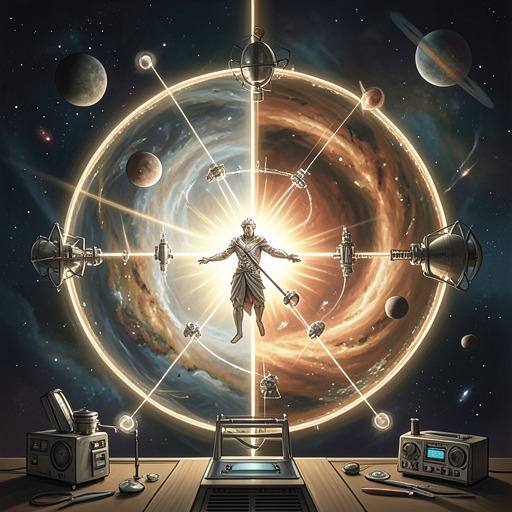
Heaven is the point from which the created universe is ordered. The Son of God, accompanied by celestial attendants, rides from Heaven into Chaos to create new worlds. With golden compasses he marks the circumference of the universe, and the divine Word brings structure to the formless abyss. Light emerges, darkness is divided from it, and the firmament separates the waters. Creation is therefore staged as a movement from heavenly speech and measure into ordered material existence.
The creation of humanity extends Heaven’s authority into the earthly world. God forms Adam from dust, breathes life into him, and creates him in the divine image; Eve is made as his female consort for the continuation of mankind. Humanity receives dominion over the fish, birds, beasts, Earth, and every creeping thing, but this dominion is derivative, granted by God rather than self-generated. Adam and Eve are placed in the Garden of Eden with abundant freedom, limited by the prohibition against eating from the Tree of Knowledge of Good and Evil. Their command is thus a terrestrial reflection of Heaven’s structure: freedom exists, but obedience gives that freedom its moral form.
Heaven remains in communication with Earth. After the six days of Creation, God returns to his high abode and surveys the new world from his throne. The Angels celebrate with ten thousand harps, and Heaven’s gates open to receive the Creator. The poem also anticipates God’s future visits to the dwellings of just men and the sending of winged messengers on errands of grace. Heaven is therefore not sealed away from creation; it is the governing center of an ordered intercourse between the divine and the created realms.
Judgment, Mediation, and Final Significance
Heaven is also the place where the consequences of human disobedience are interpreted and where the possibility of restoration is conceived. When Adam’s original crime makes mankind subject to death and Hell, the Heavenly Host remains silent: no Angel offers to assume the mortal penalty or provide the necessary ransom. The Son of God alone volunteers to become man, surrender his glory, die for humanity, and rise victorious over Death. His offer transforms Heaven from the scene of judgment into the source of mediation and redemption.
The Son’s proposed descent does not cancel divine justice; it fulfills its demand through a willing substitute. He offers life for life and accepts that death should fall upon him, while trusting that the Father will not abandon his uncorrupted soul to the grave. The Father accepts this mission and commands that the Son join divine nature to human nature, becoming Man among men and standing in Adam’s place as the new Head of mankind. Heaven’s political and moral order is therefore completed by a theology of voluntary sacrifice: obedience reaches its highest form not in passive submission but in freely accepted self-giving for the salvation of others.
The same pattern governs Raphael’s account of the celestial war to Adam. Heaven’s history is disclosed as a warning because Satan now seeks to seduce Adam into the same disobedience that ruined the Rebel Angels. The location becomes a remembered moral landscape: its brightness, ranks, decrees, battle, and restored joy teach Adam that those who stood did so freely and that those who fell cannot blame necessity. Heaven thus gives the poem its interpretive framework for human freedom, showing that the possibility of obedience is inseparable from the possibility of revolt.
At the level of the wider human future, Heaven’s order is echoed in the promise of restored mankind. The laws, sacrifices, Tabernacle, Ark, and divine presence among the chosen people anticipate the greater Mediator who will make reconciliation possible. Heaven is consequently not only the lost height from which Satan falls or the remote home toward which the redeemed aspire. It is the source, measure, and destination of the poem’s movement from Creation through rebellion, judgment, sacrifice, and restoration. Its radiance gives form to the universe; its law exposes false liberty; its victory confines revolt; and its grace opens the way for humanity to return to blessedness.